The Adventure of Painting Outdoors
I paint nature. I live in it, I am part of it, and whenever possible, I work outdoors. It is the space where my practice expands most truthfully, though never without its unexpected challenges.
I have spent years creating outside, including nine years living in the Costa Rican rainforest, and that experience profoundly transformed both the way I inhabit the world and the way I paint. There, my left hand developed abilities it had never possessed before, and my psychomotor skills reached a level of agility that surpassed even what I had acquired through juggling. I learned to paint from a state of expanded attention, connected to intuition and perception, while that same hand became capable of catching mosquitoes with lizard-like precision without breaking the thread of creation. The only thing I lacked was a chameleon’s tongue to catch them in mid-air and feed myself at the same time; perhaps with a few more years of jungle practice I might have reached that evolutionary stage.
In the rainforest, one is never alone. There are always creatures appearing: an animal crossing by, monkeys singing in the distance, insects of impossible forms, colours that never repeat themselves, and sounds so overwhelming that they leave room for little else to be heard. This abundance of forms, colours, and life becomes deeply imprinted on the retina and eventually filters into my work. Even when I paint in an enclosed, greyish space, my palettes remain wild, expansive, uncontrollably vibrant and colourful. I simply cannot help it.
Painting in nature opens moments that are difficult to explain with words. There are instances, states of attunement that are hard to describe, in which the boundaries between the observer and the observed disappear. It is a feeling of wholeness, of being inside something immense and alive, a state of profound connection. I could call it magic. In that state, nature responds. Messages appear. Coincidences. Presences.
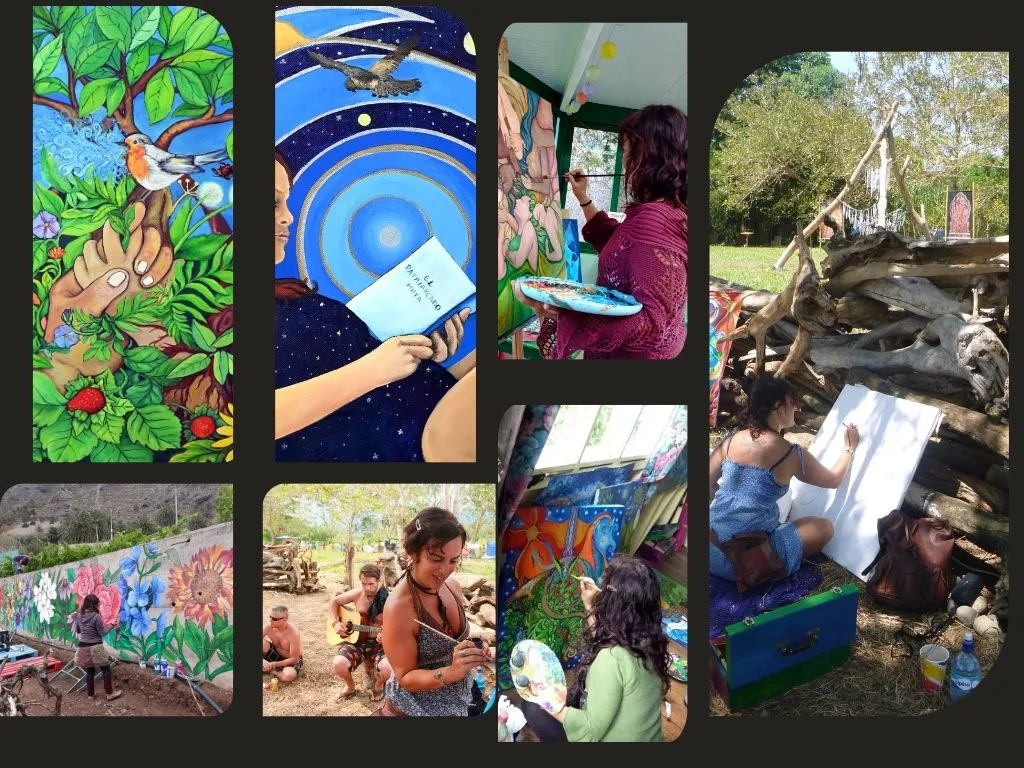
I have experienced scenes that remain etched into memory as part of the creative process. Once, while painting a work for my son — to whom I have dedicated a painting every year since his birth, and who appears each January in my calendars — I was working on an image in which his hand and mine were holding a singing robin, the three of us intertwined. At that very moment, a robin flew into the window overlooking the vegetable garden. Nothing happened to it, yet it felt like a call. A presence. A reminder of that strange synchronicity between what is created and what unfolds beyond the painting.
On another occasion, while painting in the studio of my home and smallholding — an open space sheltered on its northern side from the ever-present trade winds that sweep through the small village where I live — a kestrel entered and landed on a canvas that alluded to patriarchy. That gesture became permanently inscribed in the work, as if the bird itself had intervened in the piece. Since then, the painting has lived with that mark, both a wound and a sign. I transformed the work by incorporating that presence, as a reminder that the struggle against patriarchal injustice remains necessary, and that the hope for a more just world is still breathing.
Creating in nature means accepting that life can never be fully controlled. The wind moves the papers, the rain forces one to stop, insects reclaim their space, and animals appear when least expected. Yet it also means understanding that the artwork does not end at the edges of the canvas. It becomes part of a broader conversation with the land, with the beings that inhabit it, and with something that, in its own mysterious way, seems to respond whenever one is willing to listen.